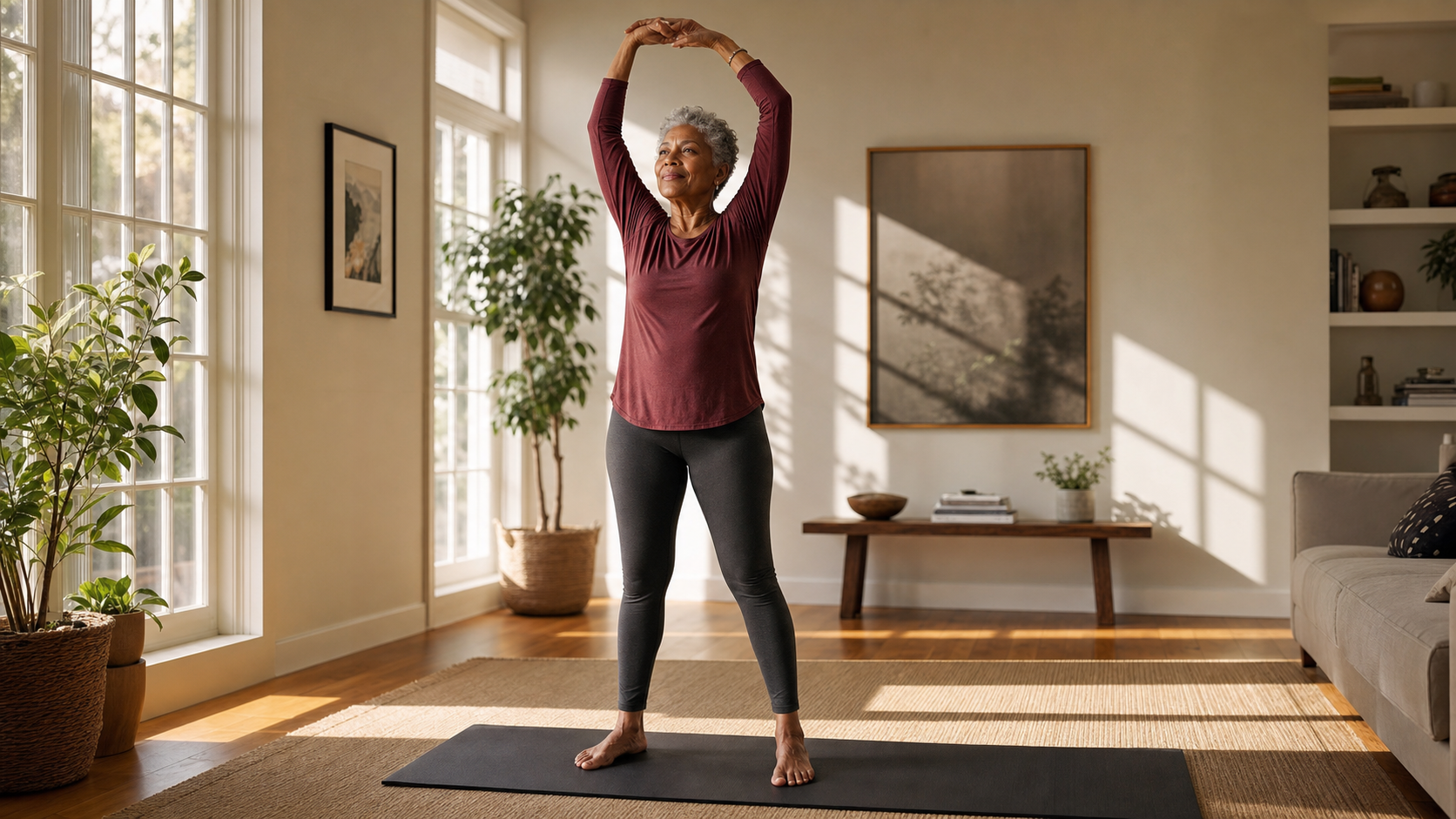
I'll ask you the same question I ask every client who sits down with me for the first time: "When's the last time you touched your toes, reached both hands overhead, or turned around to look behind you in the car without your whole body joining in?" Most people laugh a little, then admit it's been a while. That laugh tells me everything I need to know.
Here's the truth nobody tells you: strength gets all the credit, but flexibility and mobility are what let you actually use that strength in real life. You can have strong legs and still struggle to get in and out of a car if your hips are locked up. You can have a strong back and still throw it out reaching for something on a top shelf if your shoulders and spine haven't moved through their full range in years.
Stretching isn't the warm-up act. For active adults over 60, it's a headline event — and it belongs right at the center of any real longevity plan.
Why Flexibility Quietly Declines After 60 — And Why It's Not "Just Aging"
Flexibility loss doesn't happen overnight. It happens through years of sitting more, moving through a narrower range of motion, and simply not asking your joints to do the things they're capable of. Connective tissue — the fascia, tendons, and ligaments around your joints — becomes less pliable over time, especially without regular movement through full range. Add in old injuries, favored movement patterns, and hours spent in chairs and cars, and you get the tightness so many people chalk up to "getting older."
But here's what I want you to hear clearly: tight hips, stiff shoulders, and a cranky lower back are not a life sentence. They're the predictable result of tissue that hasn't been asked to move well in a long time. And tissue that hasn't moved well can be taught to move well again — at 62, at 71, at 80. I've watched it happen hundreds of times.
"Stiffness isn't a diagnosis — it's a habit your body picked up. And habits can change at any age, if you give your body a reason to." — Coach Kareem Vance
Stretching vs. Mobility Work: They're Not the Same Thing
This trips up a lot of people, so let's clear it up. Stretching is holding a position to lengthen a muscle — think reaching for your toes and holding it for 20-30 seconds. Mobility work is actively moving a joint through its full range, under control, often repeatedly — think slow shoulder circles or gentle hip rotations. Both matter, and they do different jobs.
- Stretching helps lengthen tight muscles that have shortened from disuse — like hip flexors from too much sitting.
- Mobility work teaches your nervous system and joints to move confidently through a full range, which is what actually shows up when you're reaching, turning, or stepping over something.
- Static stretching is best after activity or in the evening, when muscles are warm and relaxed.
- Mobility work is ideal first thing in the morning or before activity, to wake up the joints and prep them for the day.
The best programs — the ones I build for my clients here in Olive Branch — use both. Neither one alone gets you all the way there.
The Stretches That Matter Most for Daily Life
I could give you fifty stretches. I'm not going to. Instead, here are the four areas that cause the most real-world trouble when they're tight, and the stretches I come back to again and again with my clients.
- Hip flexors: Tight hip flexors from sitting pull your pelvis out of position and are a major contributor to lower back pain. A gentle kneeling hip flexor stretch, held for 30 seconds per side, undoes hours of chair time.
- Shoulders: Reaching overhead, into the back seat, or up to a cabinet all depend on shoulder mobility. Doorway chest stretches and gentle cross-body shoulder stretches keep this range available to you.
- Hamstrings: Tight hamstrings change how you bend, walk, and even how your lower back feels. A seated or standing hamstring stretch, done slowly and without forcing it, pays off every time you bend to tie a shoe.
- Spine: Rotation and extension through the spine fade fast without regular movement. Seated spinal twists and gentle cat-cow movements keep you able to turn, twist, and look over your shoulder — literally and figuratively.
None of these require special equipment or a lot of time. What they require is consistency, and doing them with the right form so you're actually loosening the right tissue instead of compensating somewhere else.
"You don't need forty-five minutes and a yoga mat. You need five honest minutes a day, aimed at the right places, done consistently. That's what actually moves the needle." — Coach Kareem Vance
The Real Reason This Connects to Fall Prevention and Longevity
Here's where stretching stops being a "nice to have" and becomes something much bigger. Falls are one of the biggest threats to independence after 60 — and tight, restricted joints are a huge, under-discussed contributor. When your hips, ankles, and spine can't move through their full range, your body loses some of its ability to catch itself. A stumble that a mobile body could recover from becomes a fall for a stiff one.
Flexibility also protects the joints that carry you through decades of movement. Tight tissue changes how load travels through your knees, hips, and back — often in ways that create pain and limit activity over time. Keeping your body supple isn't about touching your toes for its own sake. It's about preserving your ability to catch yourself on a curb, step over a garden hose, or twist to grab something without a shooting pain reminding you not to do that again.
Longevity isn't just about how long you live — it's about how well you move through all those years. Flexibility and mobility work are some of the most underrated tools for making sure your later decades look like more independence, not less.
Building a Simple Daily Routine You'll Actually Stick With
The best stretching routine is the one you'll actually do. I don't hand my clients complicated programs with twenty movements — I build something they can realistically fit into a normal day, then we build consistency from there.
- Pick one time of day and attach it to something you already do — after your morning coffee, before bed, right after a walk.
- Start with just the four areas that matter most: hips, shoulders, hamstrings, spine.
- Hold each stretch for 20-30 seconds, breathing normally — never bouncing, never forcing.
- Add gentle mobility movements in the morning to wake up your joints before you need them.
- Track how you feel, not how far you can reach. Less stiffness getting out of bed is a real win.
Five to ten minutes a day, done consistently, will outperform an occasional hour-long stretching session every single time. This is coaching, not punishment — it should feel good, not like a chore you're gritting your teeth through.
5 Stretches to Start This Week
- Kneeling hip flexor stretch — 30 seconds per side, once in the morning and once in the evening.
- Doorway chest and shoulder stretch — 30 seconds per side, great after sitting for a while.
- Standing or seated hamstring stretch — 30 seconds per side, done slowly with no bouncing.
- Seated spinal twist — 20 seconds per side, a gentle way to keep your rotation available.
- Cat-cow spinal movement — 8-10 slow repetitions to loosen the whole back before your day starts.
You Don't Have to Guess Your Way Through This
Every body carries its own history — old injuries, favored patterns, areas that guard themselves without you even realizing it. The stretches above are a great starting point, but the real value comes from a coach who can look at how you move, spot what's actually limiting you, and build a plan around your body specifically.
That's exactly what a coaching relationship with me looks like. As a NASM-certified coach with 25+ years of fitness coaching experience, I've helped people all over the Memphis and Olive Branch area move with less pain, more confidence, and a lot more freedom in their daily lives. Flexibility and mobility work are built into every plan I create — because strength without the ability to use it fully isn't the whole picture.
Move Better. Stay Independent. Enjoy Life Longer.
Kareem Vance Fitness — Olive Branch, MS. Stronger for Life.